
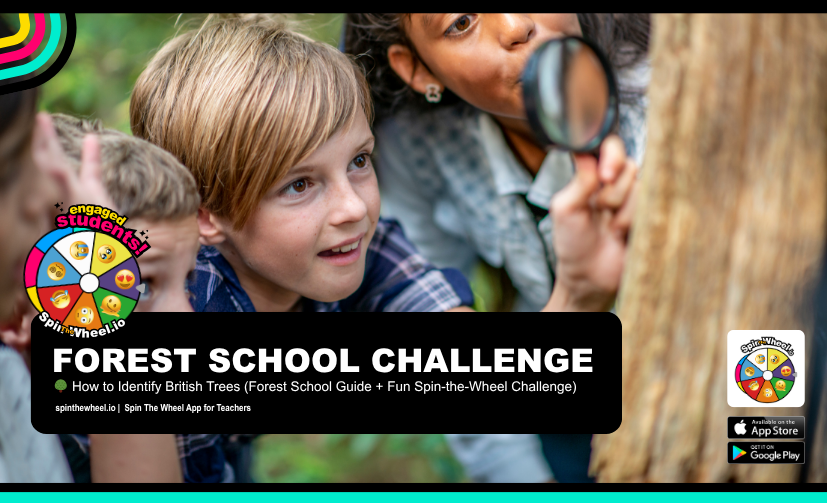
How to Identify British Trees (Forest School Guide + Fun Spin-the-Wheel Challenge)
by spinthewheel.io | Interactive tool for the Teaching Community
British woodlands are full of fascinating trees, from towering oaks to delicate silver birch. For learners in Forest School settings, tree identification is an ideal activity because it builds observation skills, scientific thinking, and a real connection to nature.
This guide gives teachers a simple, practical way to help children identify common British trees using easy-to-spot features, followed by an optional interactive Spin-the-Wheel scavenger hunt to make learning even more engaging.
🍃 How to Identify British Trees
Tree identification works best when children learn to combine several clues rather than relying on just one feature. The more features they notice, the more confident they become.
🌱 1. Leaves (or Needles)
Leaves are often the easiest starting point.
Look for:
- Shape (round, lobed, needle-like)
- Edge (smooth, serrated, wavy)
- Arrangement (opposite, alternating, clustered)
Common examples:
- 🌳 Oak → lobed leaves
- 🌿 Birch → small triangular leaves
- 🌲 Pine → long needle clusters
- 🌳 Sycamore → large, pointed leaves
Leaves are especially useful in spring and summer when they are fully developed.
🌳 2. Bark
Bark is a key feature all year round, especially in winter.
Look for:
- Texture (smooth, rough, flaky, ridged)
- Colour (grey, brown, white, multi-toned)
- Patterns (stripes, peeling layers)
Common examples:
- 🌳 Beech → smooth grey bark
- 🌳 Oak → deeply ridged bark
- 🌿 Silver birch → white, peeling bark
Encourage children to use their sense of touch (carefully) to compare textures.
🌰 3. Seeds, Fruits, and Cones
Seeds often give away a tree’s identity.
Look for:
- Size and shape
- Whether they are in cones, pods, or clusters
- If they are still attached or fallen
Common examples:
- 🌳 Oak → acorns
- 🌳 Sycamore → “helicopter” seeds
- 🌿 Holly → red berries
- 🌲 Pine → cones
Autumn is the best season for seed spotting.
🌿 4. Tree Shape and Growth Habit
Even from a distance, trees can often be recognised by their silhouette.
Look for:
- Height and spread
- Rounded vs. conical shape
- Branch structure
Common examples:
- 🌳 Oak → wide, spreading canopy
- 🌿 Birch → tall, thin, airy crown
- 🌲 Spruce → tall, triangular shape
🔍 5. Putting It All Together
The key message for learners:
“Never guess from just one clue, combine bark, leaves, seeds, and shape.”
This helps children think like real scientists and improves observation accuracy.
Extra Activity: Spin-the-Wheel Tree Scavenger Hunt
To make tree identification more engaging, add a game-based layer using a Spin the Wheel challenge.
This wheel turns tree identification into a fun outdoor mission generator.
How It Works
- Open the Spin the Wheel link on a tablet or teacher device
- Spin to generate a challenge
- Pupils explore the outdoor space to complete the task
- They observe, compare, and identify trees using clues
🌳 Example Wheel Challenges
- Find a tree with rough bark
- Find a tree with smooth bark
- Find a tree with needles
- Find a tree taller than you
- Find seeds or fruit on the ground
- Find a tree with a wide canopy
- Find something a tree has dropped
Each spin becomes a mini mission that encourages close observation and movement.
Why Add the Wheel?
The Spin-the-Wheel activity helps to:
- 🎮 Increase engagement through game-based learning
- 🔍 Encourage careful observation
- 🌳 Support outdoor exploration
- 🤝 Promote teamwork and discussion
- 🌱 Build confidence in identifying nature
It transforms tree identification from a worksheet task into an active investigation.
🍂 Extension Ideas
- 🌦 Seasonal wheel changes (focus on buds in spring, seeds in autumn)
- 🧭 Tree detective trail (different wheel challenges in zones)
- 📸 Photo challenge (capture evidence for each spin)
- 🗺 Class tree map (locate and label trees found)
🌳 Tree identification is one of the most powerful Forest School learning experiences because it teaches children to slow down, look closely, and interpret the natural world.
By combining simple observation skills with a Spin-the-Wheel scavenger hunt, pupils don’t just learn tree names; they learn how to read the living landscape around them. Every tree becomes a clue. Every spin becomes an adventure!
