
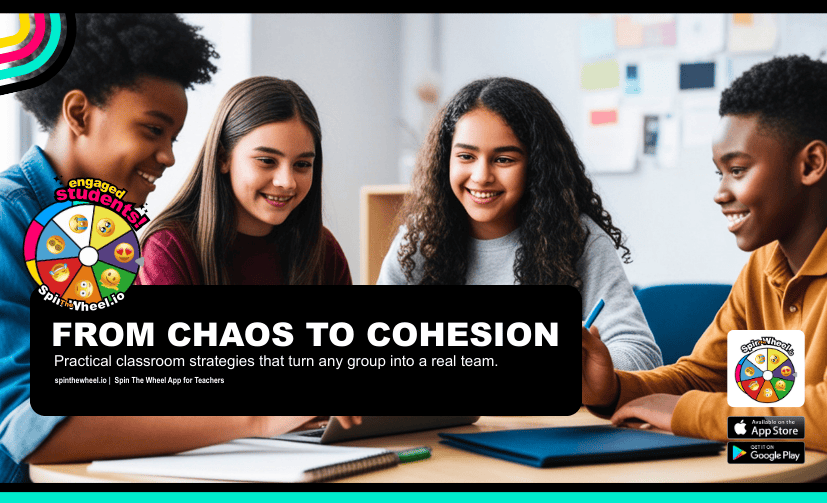
From chaos to cohesion: Practical classroom strategies that turn any group into a real team
by spinthewheel.io | Interactive tool for the Teaching Community
The Educational Value of Collaborative Group Work
Collaborative learning has become a central component of contemporary pedagogy, reflecting a shift away from passive instruction towards active, socially constructed knowledge. When pupils work in groups, they practise negotiation, communication and shared problem solving while developing a sense of responsibility for collective outcomes. Educational research consistently demonstrates that cooperative learning environments enhance motivation and deepen understanding because learners engage with content through dialogue and peer explanation. Structured interaction also supports inclusion by giving quieter pupils opportunities to participate within smaller social units. The development of these interpersonal competencies prepares learners not only for academic success but also for participation in wider social and professional contexts.
The Teacher as Facilitator and Social Architect
The teacher’s role within group work extends beyond instruction into the deliberate cultivation of a supportive learning climate. Effective facilitators establish clear behavioural norms and promote respectful dialogue from the outset. By modelling empathy and constructive feedback, teachers encourage pupils to express ideas without fear of judgement. Leadership in this context involves balancing structure with autonomy. Teachers guide students through challenges while allowing them to experience ownership over group decisions. Conflict is framed as a natural and potentially productive element of collaboration rather than a disruption to be suppressed. Through reflective questioning and consistent expectations, teachers help pupils develop emotional awareness and accountability within the group.
 Related Article | Teachers Say Grouping Students is a Major Source of Stress
Developmental Phases of Group Formation and Collaboration
Educational practice reflects well established models of group development which suggest that teams evolve through predictable stages. During the orientation phase, pupils often experience uncertainty regarding roles and expectations. Structured introductions, shared rule setting and clearly defined goals create psychological safety and reduce initial anxiety. As the group moves into a resistance or conflict phase, differences in opinion may surface. Guided dialogue enables pupils to recognise disagreement as an opportunity for learning rather than a threat to cohesion.
In the working phase, communication patterns stabilise and cooperation becomes more fluid. Pupils begin to share responsibility for tasks, demonstrate trust and provide constructive peer support. The teacher’s role shifts towards observation and targeted guidance rather than direct control. Finally, during the reflection phase, pupils analyse both achievements and difficulties. Reflective practice supports metacognition by encouraging learners to consider how their behaviour influences group outcomes and future collaboration.

Related Article | Brain Breaks in Early Education
Creating Conditions for Effective and Inclusive Teams
Strong classroom groups are built upon shared values and emotional safety. Trust develops when pupils feel listened to and respected, and when expectations remain consistent. Clear roles help prevent dominance by more confident personalities while ensuring that quieter members have defined opportunities to contribute. Open communication fosters a sense of belonging and reinforces the idea that success is collective rather than individual. Teachers who intentionally cultivate positive group norms often observe increased engagement and reduced social tension among pupils.
Engagement Through Structured yet Playful Classroom Practices
Interactive teaching strategies help pupils practise collaboration in authentic contexts. Discussion based learning, collaborative storytelling and problem solving tasks encourage learners to engage actively with each other’s perspectives. Recent approaches to classroom engagement also highlight the value of simple, low pressure participation tools. Activities such as random selection through a classroom “spin the wheel” or other gamified mechanisms can reduce anxiety around volunteering, distribute opportunities fairly and introduce an element of playfulness that lowers social barriers. Research on gamification in education suggests that small elements of chance and novelty increase motivation and participation by shifting attention away from fear of evaluation towards curiosity and shared enjoyment. Such tools can also help teachers avoid perceived favouritism when forming groups or choosing participants, thereby strengthening trust in the process.
 Download The App | Available at Google Play and App Store
References:
SpinTheWheel.io. (2026). Practical classroom strategies that turn any group into a real team. [Website]. https://www.spinthewheel.io
Johnson, D. W., and Johnson, R. T. (2009). An Educational Psychology Success Story: Social Interdependence Theory and Cooperative Learning. Educational Researcher.
Tuckman, B. W. (1965). Developmental Sequence in Small Groups. Psychological Bulletin.
Deterding, S., Dixon, D., Khaled, R., and Nacke, L. (2011). From Game Design Elements to Gamefulness: Defining Gamification. Proceedings of the 15th International Academic MindTrek Conference.
Kapp, K. M. (2012). The Gamification of Learning and Instruction. Pfeiffer.